


Two businesses can offer the same services, similar prices and the same level of experience, yet receive completely different results from their websites.
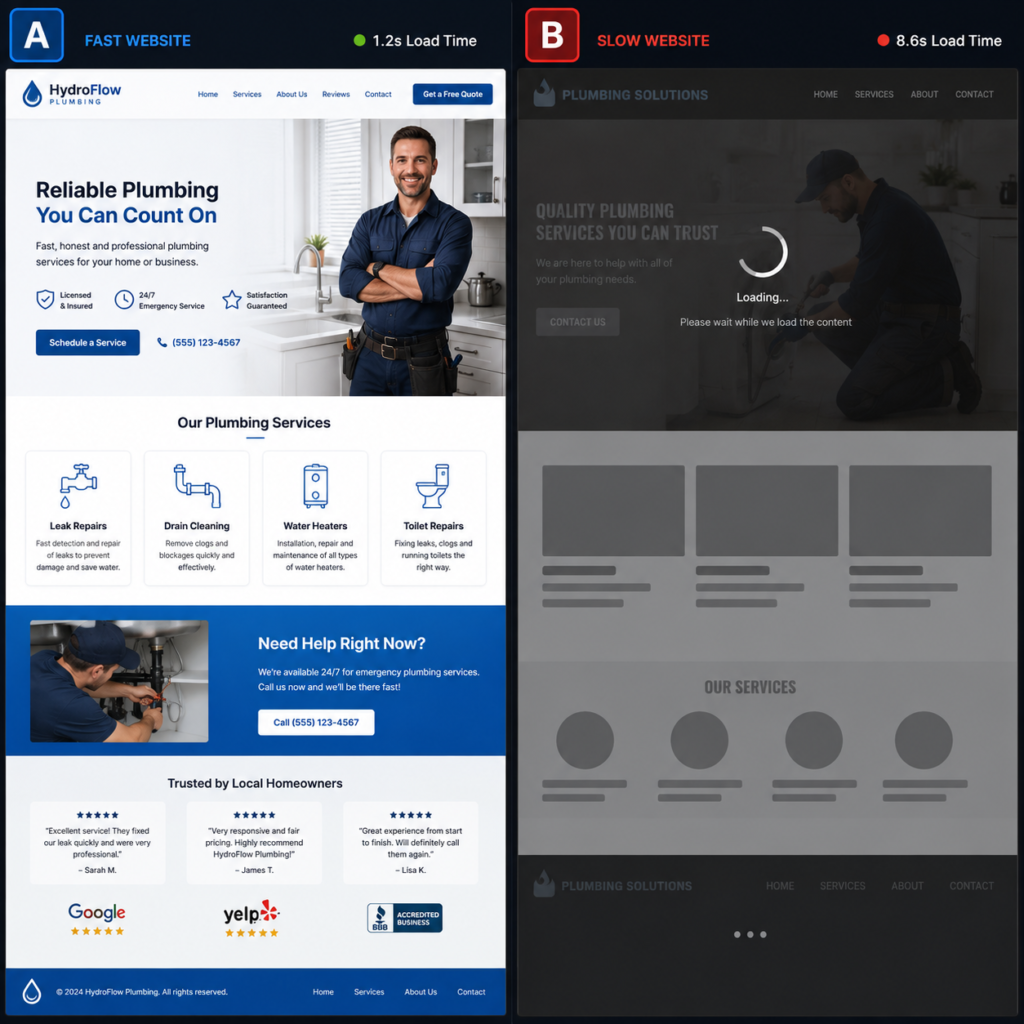
In this example, Website A loads in only 1.2 seconds. Visitors can immediately see the company’s services, reviews, contact details and booking buttons. Website B takes 8.6 seconds to load, leaving the visitor looking at unfinished sections and a loading screen.
The difference may only be a few seconds, but online those seconds matter. When a website takes too long to load, visitors may leave before they even see what the business offers.
A slow website does not only create frustration. It can also make the company appear outdated, unreliable or less professional than its competitors.
Why Website Speed Matters
When somebody visits a business website, they usually want information quickly. They may be looking for a service, checking prices, comparing companies or trying to find a phone number.
If the page does not load properly, the customer cannot take the next step.
Website A immediately gives the visitor everything they need: clear services, trust signals, customer reviews and visible contact buttons. Website B hides most of that information behind a long loading time.
Even if Website B belongs to an excellent company, the visitor may never stay long enough to discover that.
Speed Affects the First Impression
Customers often judge a business by the quality of its website. A page that loads quickly and works smoothly can make the company feel organised, modern and trustworthy.
A slow or unfinished-looking website can create the opposite impression. Visitors may wonder whether the business is still active, whether the booking form works or whether their information will be handled securely.
The website becomes part of the customer’s first impression of the entire company.
What Usually Makes a Website Slow?
Several common problems can reduce website performance:
- Images uploaded in unnecessarily large file sizes
- Too many plugins or unused features
- Heavy videos and animations
- Poorly configured hosting
- Missing caching and image optimisation
- Too many external scripts
- A design that performs badly on mobile devices
A website may look good on the surface while still having serious performance problems behind the scenes.
A Fast Website Makes Taking Action Easier
Website speed is not only a technical issue. It affects how easily visitors can contact the business, request a quote or make a booking.
On Website A, the visitor can immediately press Book Now, call the business or explore its services.
On Website B, the visitor must wait before those options become available. Every additional delay creates another opportunity for the customer to close the page and choose a competitor.
A professional website should remove unnecessary obstacles and make the next step clear.
Improving Speed Does Not Always Require a New Website
In many cases, an existing website can be improved without rebuilding everything from the beginning.
Performance can often be improved by:
- Compressing and resizing images
- Removing unnecessary plugins
- Enabling browser and server caching
- Optimising scripts and website code
- Improving the mobile layout
- Choosing better hosting
- Testing the website regularly
The goal is not only to achieve a better technical score. The real goal is to create a faster and smoother experience for potential customers.
Is Your Website Helping or Slowing Down Your Business?
A website should work as a tool that supports the business. It should help customers understand the offer, trust the company and take action without unnecessary delays.
If visitors are waiting several seconds for the page to load, they may leave before seeing the services, prices or contact information.
MP Development creates and improves professional websites that are fast, responsive and easy to use. We focus on both design and performance, helping businesses provide a better experience and avoid losing potential customers online.